

China stays / A practical booking guide
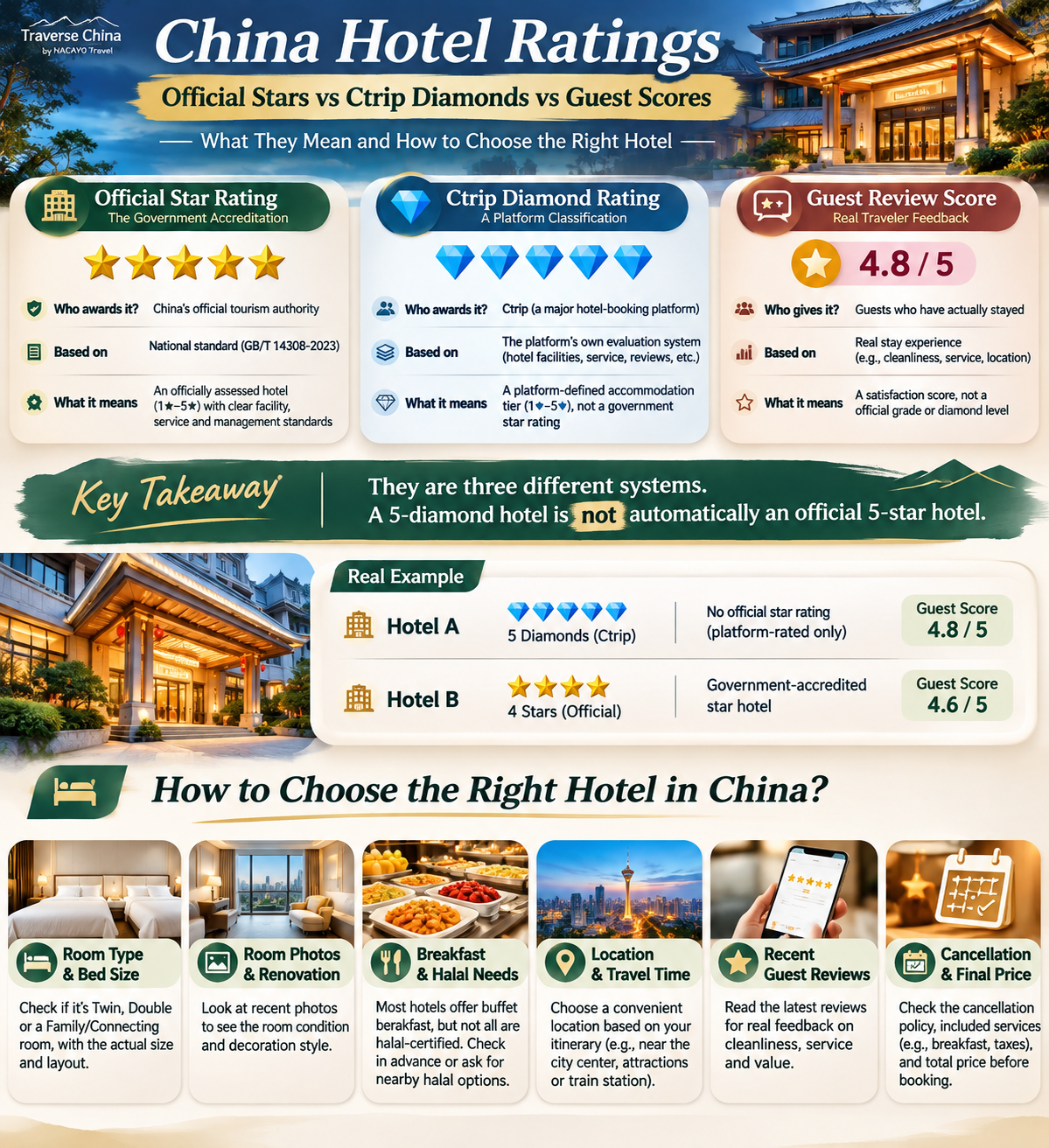
Five stars, five diamonds, a 4.8 guest score—and somehow none of them tells you whether you’ll actually like the room.
When I compare hotels for a China trip, I start with the room rather than the badge. Was it opened recently? Is the room in a renovated wing? Is that “king bed” really wide enough? And where is the hotel in relation to tomorrow morning’s pickup?
One detail people often pay for and never use is breakfast. If the car leaves at 6 a.m., I’d rather put that money towards a better room—or ask whether the hotel can prepare something to take away.
This is the kind of hotel research that’s worth doing before you book. The star and diamond labels are useful; they simply aren’t the whole story.
5-Star vs 5-Diamond in China: What’s the Real Difference?
A five-star hotel and a five-diamond hotel may look equally impressive on a booking page, but those labels come from different places. Official hotel stars follow China’s GB/T 14308-2023 framework. Ctrip diamonds are the platform’s hotel classification. A score such as 4.8/5 comes from guest feedback. None is a direct conversion of the others.
An officially assessed hotel category. A luxury name, a hotel facade or a platform icon alone is not evidence of accreditation.
Helpful for narrowing a list on Ctrip, but not a substitute for an official star-rating record. A five-diamond property may or may not also be officially five-star.
Read the number of reviews, when they were posted, and what travellers actually experienced. The score is not a room inspection or a legal qualification.
Once I understand the label, I move on. A carefully maintained older five-star hotel can be a wonderful stay; a newer four-diamond property can feel fresher and more convenient for the same budget. I wouldn’t choose either without looking at the actual rooms.
Opening Year and Renovation Date: Often More Useful Than the Rating
Imagine choosing between a famous five-star hotel that opened twenty years ago and a four-diamond hotel that opened last year. The older property may have a beautiful lobby and excellent staff. The newer one may offer better bedside charging, a simpler shower layout and a less tired-looking bedroom. Or the older hotel may have renovated its rooms beautifully. The opening year gives me a clue, not the answer.
All else being equal, I often start by looking at hotels opened in the last two or three years. Then I check guest photos and reviews. A brand-new building with noisy air-conditioning and poor housekeeping isn’t a bargain just because it is new.
Check four dates, not just one
Opening year
When the property started operating. A useful clue about the original building and equipment, not proof of room condition today.
Last renovation
Ask whether the date covers the whole property or just the lobby, restaurant or a selection of rooms.
Your room’s renovation
Some hotels have an old wing and a renovated wing. Confirm the actual booked room category and building.
Recent stay photos
Look at guest-uploaded pictures from the past few months, especially bathrooms, windows, corridors and bedding.
What about a hotel that’s just been renovated?
A freshly renovated room can look great in photographs but still smell of new furniture, paint or adhesives. I pay attention to reviews mentioning odours, unfinished work or construction noise, particularly for families travelling with young children or anyone sensitive to smells.
Some people prefer not to stay immediately after a major refurbishment, or leave a few months to a year as a precaution. That’s a preference, not a proven universal safety period. The actual materials, ventilation and indoor conditions matter more than the date on a listing. If a room smells strongly or feels uncomfortable, ask to change rooms or hotels.
How to Read a Chinese Hotel Room Listing Before Paying
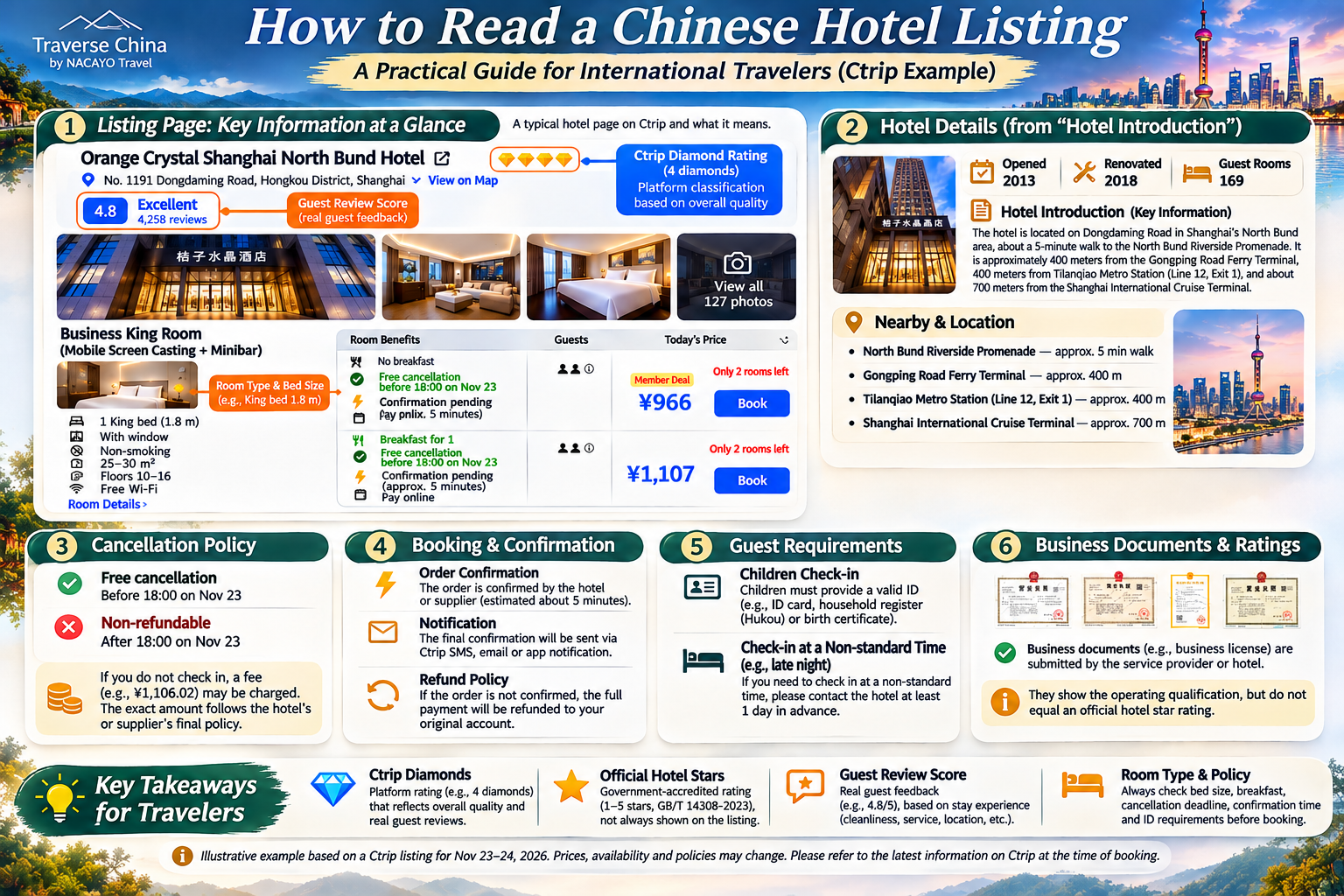
Hotel galleries are often beautiful: a dramatic lobby, a lovely restaurant, a suite with a view. But when you click Book, you may be reserving the smallest room in a different wing. I always open the exact room category and its rate plan.
Take this Orange Crystal Shanghai North Bund listing as an example. The hotel shows four Ctrip diamonds and a 4.8 guest score, while the selected Business King Room is listed as 25–30 m² with one 1.8 m bed. That’s more useful than the diamond icon if you’re wondering whether two adults and their luggage will fit comfortably.
Then look a little lower on the screen. The illustrated prices show RMB 966 without breakfast and RMB 1,107 with breakfast for one person. Even when the room is identical, the rate plan changes what you pay for. The cancellation deadline and “pending confirmation” status also belong to that particular booking, not necessarily to every room in the hotel.
| On the listing | What it means | What to verify |
|---|---|---|
| 大床房 / King or Double Room | Usually one larger bed | Actual width, e.g. 1.8 m; don’t assume every “double” is a king. |
| 双床房 / Twin Room | Two separate beds | Bed widths and whether beds can be moved together. |
| 有窗 / Window | A room advertised with a window | Is it an exterior window with daylight, or an internal-facing one? |
| 无窗 / No Window | No conventional external window | Consider ventilation and how comfortable the room will feel. |
| 25–30 m² | Listed room area | Will it fit luggage, an extra bed or a family of three comfortably? |
| 含早 / Breakfast Included | Breakfast included under that rate | For how many guests, at what hours, and what food is available? |
| 免费取消 / Free Cancellation | Free within stated terms | Exact deadline, timezone, booking status and later penalties. |
Room names and translations vary by hotel and booking platform; the Chinese terms are helpful for checking a specific listing, not universal guarantees.
A few more things are easy to miss. “Connecting rooms” means rooms linked by an internal door; “adjacent rooms” may only mean next door or nearby. A “family room” may have one large bed plus a sofa bed rather than three proper beds. A room on a high floor may still face traffic or an elevator lobby. Ask for non-smoking accommodation where needed, and check recent reviews for smoke odours even when the listing says non-smoking.
A room may say “1.8 m king bed, 25–30 m², window”. For a couple, that’s usually straightforward. Add a child, a cot and two large suitcases, and the very same room could feel tight. Before paying for a “family room,” ask whether the extra bed is a proper bed, a sofa bed or simply an option that isn’t available on your dates.
Breakfast Included or Not? Check Your Departure Time First
I like a hotel breakfast when it’s a relaxed morning. But on a day-trip to the mountains, or when catching an early train, it can become a perk you’ve paid for but won’t have time to use. I decide which dates need breakfast after the itinerary is planned, not before.
Compare the actual price, not the “free breakfast” label
Suppose a room-only rate is RMB 966 and a rate with breakfast for one guest is RMB 1,107. The difference is RMB 141. These figures are an example from a dated Ctrip screenshot, not today’s rate or a price promise. If two adults are staying, you still have to ask whether the second person’s breakfast costs extra.
The question is not whether the breakfast buffet looks impressive; it’s whether you will be there to use what you’ve paid for. In the screenshot example, the two offers also have their own booking terms, so compare the entire package rather than the breakfast line alone.
City sightseeing day
If breakfast starts before your planned departure, an included option can be convenient—especially for families with children.
Early train or flight
If you must leave before breakfast opens, a room-only option may make more sense. Confirm opening time rather than guessing.
Early scenic-area entry
Ask if the property can prepare a packed breakfast (打包早餐 / 路早), when it can be collected, and whether there is a charge.
Muslim dietary requirements
A hotel buffet is not automatically halal. A packed breakfast from the same kitchen isn’t automatically halal either; verify ingredients and handling.
Ask for a breakfast box before the night of departure
Some properties can prepare a takeaway breakfast; others cannot, or require advance notice. Ask the front desk before you purchase the breakfast-inclusive rate if the early departure is already known. Check what is packed, where to collect it, and whether it is suitable for your family’s dietary needs. If the answer is no, you might prefer to arrange an appropriate meal outside the hotel.
Can the hotel prepare a takeaway breakfast for a 6:00 a.m. departure? Is it included in our room rate, and what food would be provided?
我们早上六点出发,酒店能否提供打包早餐?是否包含在房费内,具体提供什么食物?
For a Muslim family, a location near a verified suitable breakfast shop may be worth more than a large buffet you cannot use. For checking menus and food labels, see our halal food guide for China.
Cancellation, Payment and Confirmation: Three Separate Things
Here’s a common trap: the room name and photograph are identical, so two rates look interchangeable. They may not be. One lets you change your mind until tomorrow evening; another becomes non-refundable once confirmed. I read the terms of the specific rate, even when I’ve stayed at the hotel before.
- Cancellation deadline: Read the exact local date and time. “Free cancellation” usually means before a cutoff, not at any point before you arrive.
- After-deadline charge: Check whether the penalty is one night, a fixed amount or the full booking cost. Do not assume every hotel uses the same rule.
- Pending vs confirmed: “Confirmation pending (estimated five minutes)” is not the same as a confirmed reservation. Wait for the actual confirmation notice.
- Payment method: “Pay online,” “pay at the hotel,” deposits and pre-authorisations are different arrangements; read the precise terms.
- No-show or late arrival: If you land after midnight or miss a connection, tell the hotel. A no-show can trigger a charge or loss of the room under the booking terms.
- Refund destination: If a pending reservation is not accepted, check how and when money goes back to the original payment method; the supplier’s published rule governs the case.
A displayed offer permitted free cancellation before 18:00 on November 23 and became non-refundable after that. The screenshot also mentioned a possible no-show charge. These were conditions for a particular booking on that date—not permanent rules for the hotel. Always inspect the rate plan you are actually buying.
For multi-city trips, I’d usually value flexible cancellation more during the stages affected by flight schedules, train changes or winter road conditions. That doesn’t mean the cheapest fully non-refundable rate is always wrong; it means the saving should be worth the risk. Save a copy of the booking confirmation, room category and cancellation terms.
Choose the Hotel Around Your Itinerary, Not Just the City Centre
“Central location” sounds good in a hotel description, but it isn’t a plan. Check how long it will actually take to reach your first appointment, station, attraction or meal stop—and remember that a ten-minute walk with suitcases in heavy rain isn’t the same as a ten-minute walk to a café.
A convenient station or neighbourhood can save daily transport. Check both daytime sightseeing access and where you’ll return after dinner.
Calculate departure backwards: required arrival time, security or check-in buffer, real transfer time, and whether your hotel’s breakfast opens early enough.
Being in the right county isn’t the same as being close to the scenic gate. Ask for the actual driving time, road conditions and what meals are available nearby.
Heating, hot water, blackout procedures, luggage access and reliable vehicle pickup may matter more than a high platform grade.
If a hotel is close to a mosque or a suitable halal restaurant but slightly less glamorous, that may be the more comfortable option for some Muslim families. A location decision should be tied to what the travellers will actually do, not a generic list of “best areas.”
Are Chinese Homestays Better Than Hotels?
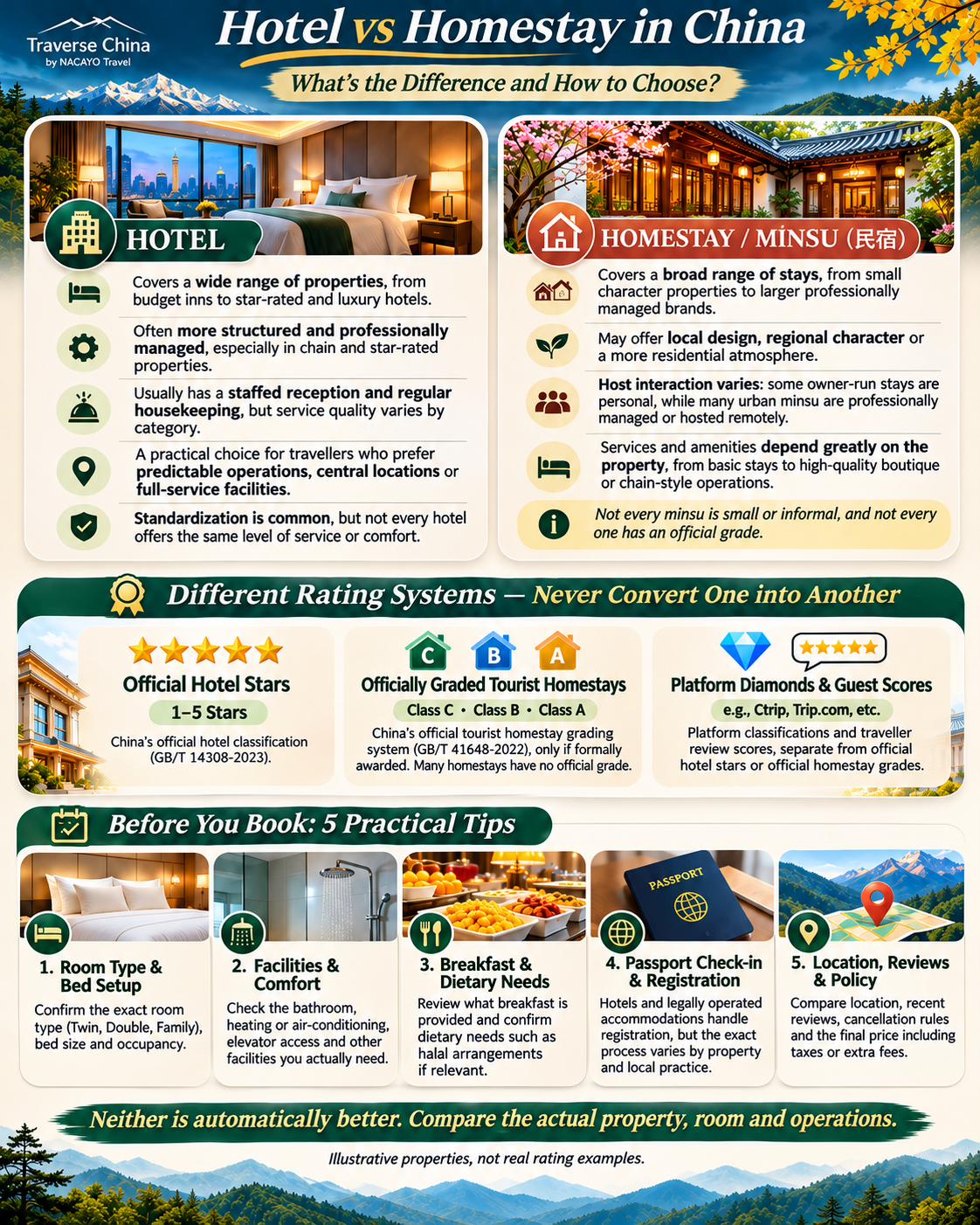
One place I would happily choose a mínsù (民宿) is a mountain village where the accommodation itself is part of the experience: a courtyard, local architecture, or a room that opens onto the scenery. In Shanghai, with a late flight and an early checkout, I’d probably lean towards a hotel with dependable reception and luggage storage.
That doesn’t mean a minsu is always small or run by a chatty owner. Many city properties are professionally managed, some by sizeable brands, and the host may never appear in person. Likewise, “hotel” can mean anything from a simple budget inn to a full-service international property.
For me the useful distinction isn’t the name on the sign. It’s what happens when you arrive with bags, need breakfast at 6 a.m., or discover your room is on the fourth floor with no lift. A beautiful countryside guesthouse can be exactly right for a slow stay—and inconvenient for a family with an older parent and several suitcases.
China also has a separate official standard for graded tourist homestays, GB/T 41648-2022, with grades C (丙级), B (乙级), A (甲级) in ascending order. Many minsu have no formal grade. Those grades can’t be converted into hotel stars or Ctrip diamonds—and they don’t tell you whether breakfast is served early.
Can Foreigners Stay in Any Hotel in China?
Foreign travellers are not generally required to book an officially star-rated hotel. China’s 2024 national accommodation measures directed authorities and platforms not to impose improper qualification barriers against receiving overseas guests. Hotels still have legal accommodation-registration duties, and individual properties need to manage check-in correctly.
For a normal hotel stay, the hotel registers foreign guests according to the applicable rules. For stays at addresses outside the hotel system, the foreign guest or accommodating person generally has to complete registration within 24 hours; a nationwide online registration option has been available since September 21, 2026. Whether a particular homestay is operated as a hotel-type lodging establishment or another kind of accommodation determines the appropriate process.
Bring your valid passport or other legally accepted travel document, check the booking name against the document, and confirm arrival arrangements with small properties beforehand—especially when reaching a remote area late at night. The fact that a property displays business certificates on a booking site does not prove that it has any official hotel star rating.
Official references: 2024 accommodation measures and the National Immigration Administration guidance linked above.
What I’d Check for a Muslim Family, Beyond Stars and Diamonds
For a Muslim family, I wouldn’t start by asking whether the hotel is “Muslim-friendly” in general. I’d ask what the family actually needs: breakfast they can eat, a room arrangement that works, perhaps a handheld bidet sprayer, and enough time to pray without making the day’s drive stressful. A five-star sign won’t answer any of those questions.
- Breakfast: Is it a shared buffet? Is a halal-certified option actually provided? If not, can the family arrange suitable food elsewhere, especially on early departures?
- Room setup: Twin or king beds, connecting rooms with an internal door versus merely adjacent rooms, extra-bed policies and children’s occupancy limits.
- Washing facilities: Does the bathroom have a handheld bidet sprayer if that matters to the guests? Is there a private shower or suitably private bathing area?
- Prayer: Enough clean space in the room, proximity to a mosque if important, and a realistic schedule. Don’t promise a dedicated prayer room unless verified.
- Minibar and shared facilities: Ask about alcohol, spa access or private pool usage only where relevant to the family’s preferences. “Private pool” does not guarantee exclusive use at all times.
- Hotel location: Is suitable dining actually reachable after the day’s sightseeing or long drive? A restaurant across town is not convenient just because it’s in the same city.
The most reliable plan is to confirm what the hotel actually offers, then make the itinerary work around it. For broader context, see our Muslim-friendly China travel guide.
Two Real Examples of Why Hotel Labels Need Checking
Jinjiang Hotel, Chengdu: official stars exist separately from the room experience
Chengdu’s Jinjiang Hotel (锦江宾馆) appears in Sichuan’s published star-rated hotel records as an official five-star property, plaque number 5150001. That is meaningful evidence of accreditation. It does not, however, tell you which room category was renovated most recently or how quiet a particular room will be. Those still deserve a separate check.
A 2026 enforcement case: “five-star” is not just a marketing adjective
In a case published by China’s market regulator in July 2026, a hotel operation in Wenchang, Hainan advertised itself as five-star despite not having participated in official star accreditation; the authority ordered corrective action and imposed a fine. The lesson for travellers isn’t to distrust every luxury hotel. It’s to ask who awarded the rating when someone claims official five-star status. Read the regulatory case.
If a quotation promises an official five-star hotel, that claim should be verifiable. After that, I’d still compare the room category, recent condition and cancellation terms. The badge helps identify a category; it doesn’t choose the room for you.
My Practical China Hotel Booking Checklist
- Right place: Check the real address, your pickup point and journey time—not just “central.”
- Right room: Confirm the exact room name, size, bed widths, number of guests, window type and building or wing.
- Right condition: Check opening year, scope of renovation, construction nearby and guest photos from recent stays.
- Right breakfast: Compare room-only and breakfast rates; check how many breakfasts, serving hours and whether an early takeaway is possible.
- Right flexibility: Record the cancellation cutoff, penalties, payment method, confirmation status and late-arrival terms.
- Right practical fit: Check heating or air conditioning, noise, bathroom arrangements, lift access and luggage storage.
- Right registration: Confirm passport check-in and applicable accommodation-registration procedure.
- Right family needs: Verify halal food, connecting rooms, children’s beds and prayer/privacy arrangements when relevant.
- Right quote: If a tour operator says “four-diamond” or “five-star,” request the proposed property name, exact room standard, breakfast terms and how substitutions are handled.
Could you confirm the hotel’s opening year, which rooms were last renovated, the exact bed configuration, whether breakfast is included for everyone, and the free-cancellation deadline?
能否确认酒店开业年份、具体哪些房间最近翻新、实际床型、是否包含所有人的早餐,以及免费取消的截止时间?
China Hotel Booking FAQs
Is a Ctrip five-diamond hotel the same as an official five-star hotel?
No. Ctrip diamonds and official hotel stars are separate classifications. A property can hold both, but one does not prove the other.
Should I always book a hotel opened within the last two years?
No. Newer hotels can have newer facilities, but service and maintenance vary. A well-managed older hotel with refreshed rooms may be a better choice.
Is a hotel renovated within the last year unsafe?
Not necessarily. Renovation date alone does not establish indoor-air quality. Review actual room conditions, ventilation, recent guest reports and the scope of the renovation; ask to change rooms if there is a strong smell or discomfort.
Can hotels pack breakfast for a very early departure?
Some can. It may require advance notice, have limited choices or incur a fee. Confirm availability, pickup time and dietary suitability before relying on it.
Are connecting rooms guaranteed when I book two rooms together?
No. Connecting rooms have an internal door, and availability should be specifically confirmed. Adjacent or nearby rooms are not equivalent.
Does “free cancellation” mean I can cancel anytime?
No. Follow the exact cutoff time and rate-specific terms. “Awaiting confirmation” also means the reservation has not yet been finally accepted.
Can foreigners book a homestay rather than a star-rated hotel?
Yes, subject to the property’s legal operation and applicable registration process. Confirm passport check-in and whether hotel-type or non-hotel registration applies.