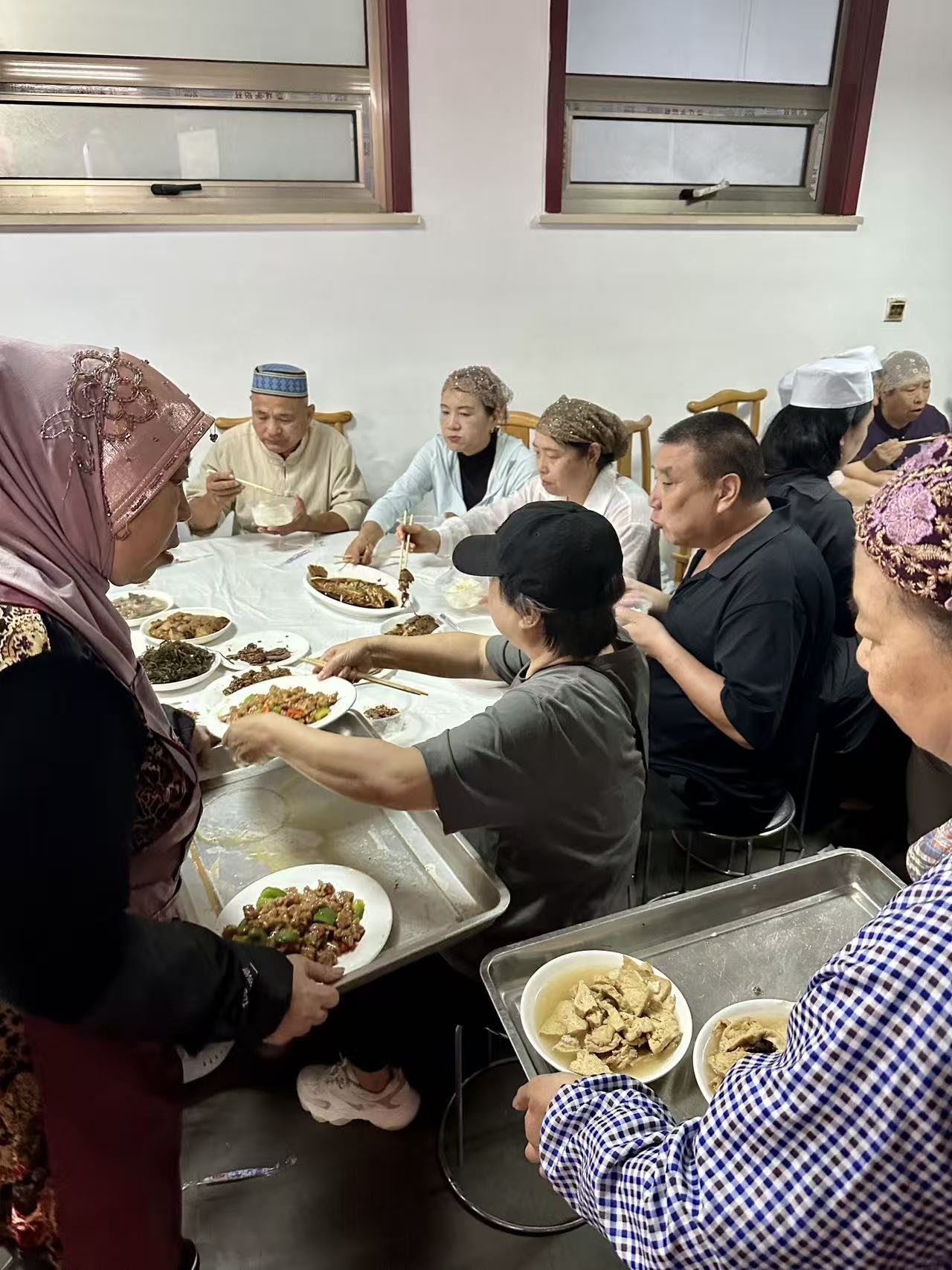
Muslim-Friendly China Travel · Practical Food Guide
You’re in China, it’s lunchtime, and you’ve
found a restaurant serving beef noodles.
The photos look delicious. The reviews
are good. Surely it’s halal?
Not necessarily.
This is one of the easiest mistakes
to make when travelling in China.
A dish can contain beef or lamb and
still not meet halal requirements.
The meat source, broth, seasonings
and cooking equipment all matter.
But don’t let that put you off
exploring Chinese food.
China has its own long-established
Muslim culinary traditions,
from hand-pulled noodles and
lamb soup to cumin-spiced skewers
and regional dishes you may never
have tried before.
The trick is knowing what to look for.
And the most useful thing to learn
isn’t a restaurant name.
It’s two Chinese characters.
Remember This Word
Qīngzhēn — Halal
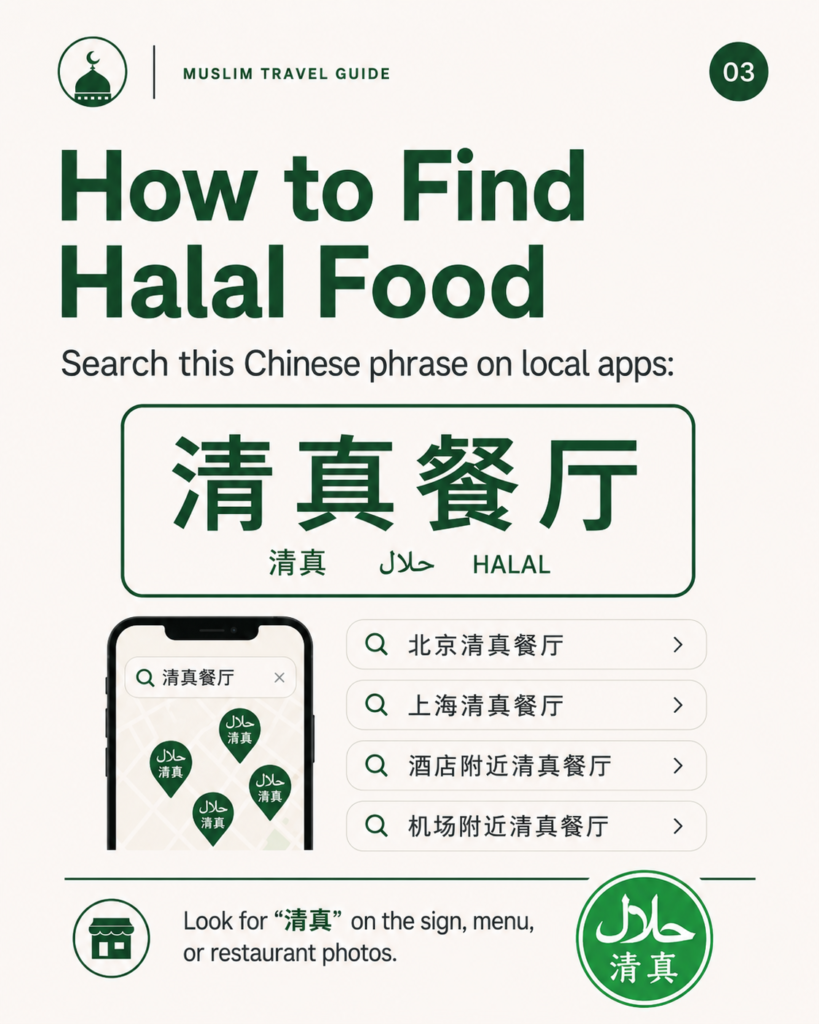
To look for halal restaurants,
search
清真餐厅
in a Chinese map or food app.
Then check the actual restaurant
and ask about anything you’re
unsure of.
Don’t just search for “beef”.
Search for halal.
1. How to Find Halal Restaurants in China
When you’re standing outside a
train station or checking into
your hotel, searching in Chinese
is often more useful than
typing “halal food near me”
in English.
Try a local app such as
Amap (Gaode Maps),
Baidu Maps or Dianping.
These are commonly used
in mainland China for
finding restaurants,
addresses and recent reviews.
What to type into the search bar
清真餐厅
Halal restaurant — the most useful general search.
清真牛肉面
Halal beef noodles — useful when you want
a quick noodle meal.
清真新疆菜
Halal Xinjiang cuisine — a way to find
restaurants serving regional food.
北京清真餐厅
Halal restaurants in Beijing.
Replace 北京 with your city name.
清真寺
Mosque. Useful when checking the
surrounding neighbourhood for
Muslim community facilities.
You can also zoom into the area
around your hotel on the map
and search for 清真餐厅 there.
This is often more practical
than trying to find a restaurant
on the opposite side of a large city.
The one-minute restaurant check
Before following the map directions,
take a moment to look at the listing.
-
Look at recent photos.
Do you see 清真 on the actual
shopfront or menu? -
Check the full menu.
Does the restaurant serve
pork dishes or alcoholic drinks? -
Read recent reviews.
Restaurant ownership, menus
and operations can change. -
Confirm in person.
If you have strict requirements,
ask the staff about the meat
and food preparation.
If the restaurant name appears
only in English on a travel website,
try finding its Chinese name
before setting off.
It makes local map searches
and communicating with drivers
much easier.
2. Does a Qingzhen Sign Mean a Restaurant Is Halal?
The word 清真 is an important
starting point.
You’ll see it on restaurants,
food shops and some packaged products.
But restaurant signs don’t all
look the same across China.
You may see Chinese characters,
Arabic script, different colours
or local documentation.
The exact rules and documentation
can vary by location.
A green sign or Arabic decoration
alone isn’t proof of a particular
halal certification standard.
If you require formal certification,
ask the restaurant whether it has
relevant documentation and who
issued it. Don’t assume one sign
means the same thing everywhere.
Why “No Pork” Isn’t Enough
Imagine ordering beef noodles
at a regular restaurant.
The meat may genuinely be beef.
But what about the soup?
Was it prepared with pork bones?
Was cooking wine used?
Was the cooking oil also used
for pork dishes?
And does the meat itself
meet halal slaughter requirements?
Those are different questions
from simply asking for
“no pork”.
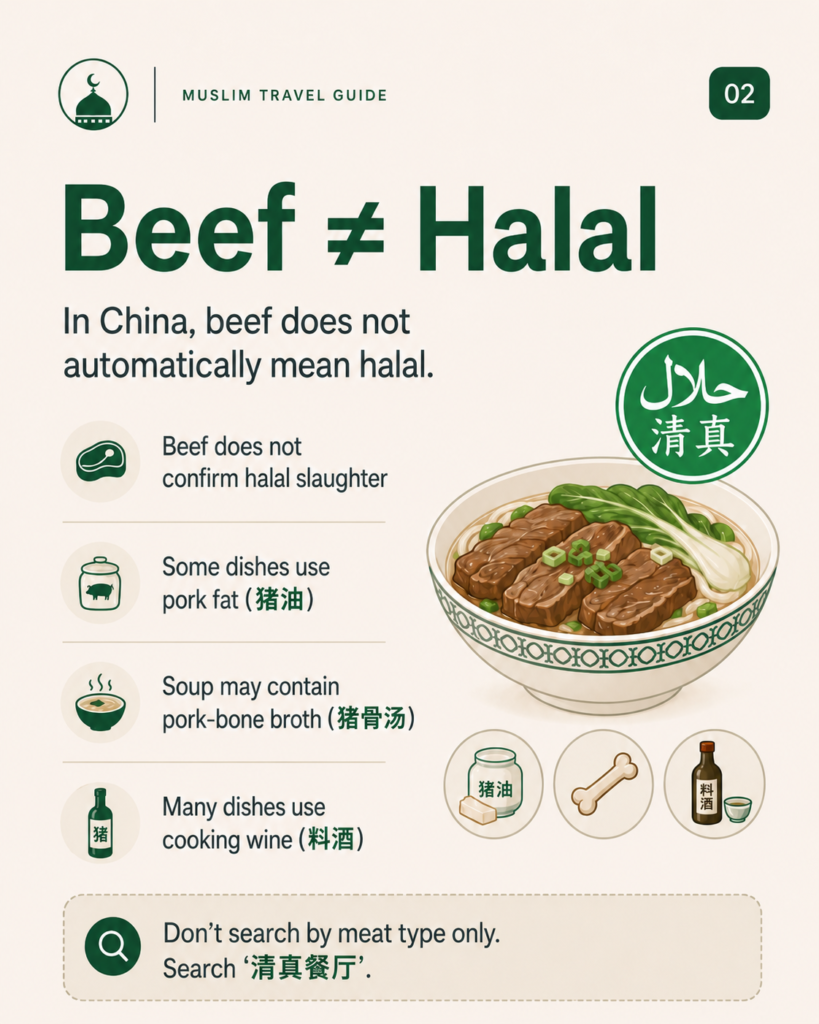
Removing pork or cooking wine
from an individual dish does not
automatically make the entire
meal halal. If your requirements
include halal-slaughtered meat
and separate kitchen equipment,
confirm those details too.
If the answers are unclear,
choose another restaurant.
3. Chinese Phrases Every Muslim Traveler Should Save
You don’t need to speak fluent Chinese.
You just need a few useful questions
saved on your phone.
You can show these sentences
directly to restaurant staff.
Keeping the Chinese text
large and easy to read
is often more helpful than
trying to pronounce everything.
Save / Screenshot This Card
我是穆斯林,请问这里是清真餐厅吗?
I’m Muslim. Is this a halal restaurant?
请问这里的肉是清真的吗?
Is the meat here halal?
菜里有猪油、猪骨汤或料酒吗?
Does the dish contain pork fat,
pork-bone broth or cooking wine?
会和猪肉共用锅具或炸油吗?
Are cooking utensils or frying oil
shared with pork dishes?
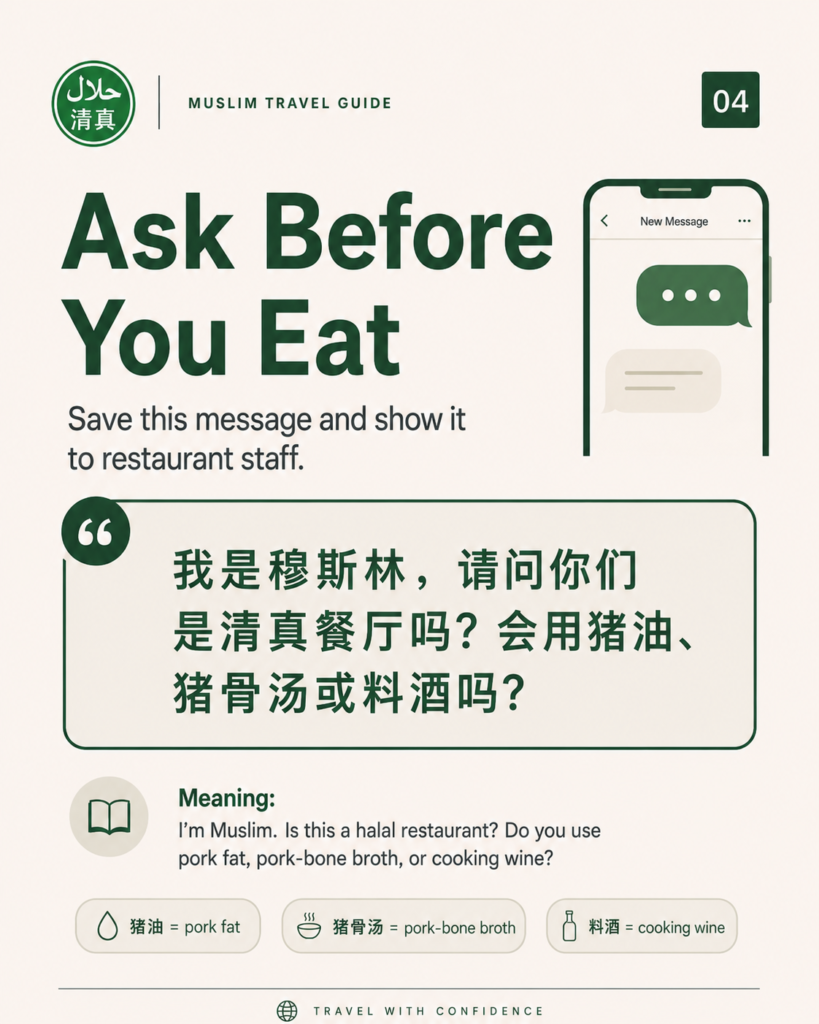
Three Chinese Ingredients Worth Recognising
猪油
Zhūyóu — Lard / pork fat
May be used in cooking,
including some vegetable dishes.
猪骨汤
Zhūgǔ tāng — Pork-bone broth
A dish may contain beef
but use a different meat
source in the soup.
料酒
Liàojiǔ — Cooking wine
Used in some Chinese dishes
and sauces during preparation.
猪肉
Zhūròu — Pork
Useful to recognise on menus,
ingredient lists and food packaging.
4. What Halal Food Should You Try in China?
Now for the enjoyable part.
One thing I wish more first-time
visitors knew is that China’s
Muslim food culture isn’t limited
to kebabs or Middle Eastern food.
There are regional noodle shops,
fragrant rice dishes, warming
lamb soups and street-food
traditions with their own
Chinese Muslim heritage.
Here are a few dishes worth
looking for at verified
halal restaurants.
The dish name alone is never
a halal guarantee.
Hand-Pulled Beef Noodles — 牛肉面
A bowl of noodles in
fragrant broth, often
with sliced beef,
herbs and chilli oil.
Lanzhou-style beef noodles
are a familiar sight
in many Chinese cities,
making them worth looking
for when you need a
satisfying everyday meal.
Remember:
Search specifically for
清真牛肉面 and check
the individual restaurant.
Not every noodle shop
with beef in its name
meets halal requirements.
Xi’an Lamb Paomo — 羊肉泡馍
This is one of the dishes
I’d encourage visitors
to try when exploring
Xi’an’s Muslim food culture.
You break flatbread
into small pieces,
then enjoy it with
a rich lamb broth.
It’s filling,
particularly lovely
in cold weather,
and a memorable part
of exploring the city
beyond its famous
historical attractions.
Choose a suitable halal restaurant,
rather than assuming every
version of the dish
is prepared identically.
Xinjiang Rice Pilaf — 抓饭
Rice, carrots, spices
and often lamb come
together in a comforting
regional dish.
Xinjiang cuisine has
its own distinctive
flavours and traditions.
If you enjoy rice dishes,
this one is well
worth seeking out.
Again, confirm the
restaurant and meat
preparation rather
than relying on
the dish name.
Cumin-Spiced Meat Skewers — 烤肉串
The smell of grilling
meat and cumin can
be hard to resist,
especially in the
evening markets
of northwest China.
Lamb skewers are
a popular regional
favourite.
Order from a restaurant
or food stall whose
halal suitability
you’ve confirmed.
Halal Hot Pot
Yes, you can enjoy
a hot pot experience
during a Muslim-friendly
China trip.
The important detail
is the restaurant.
A regular hot pot
restaurant may serve pork,
use mixed broths or
share ingredients
and equipment.
Choose a halal restaurant
that can explain its
broth, meat sourcing
and preparation practices.
without constantly worrying
about ingredients?
A well-planned travel route
can include suitable restaurants
near your sightseeing stops,
rather than forcing you
to search from scratch
every lunchtime.
5. Which Cities in China Are Easier for Halal Dining?
This is where your experience
can change quite dramatically.
Finding a halal restaurant
in a major city with an
established Muslim community
is different from looking
for lunch next to a
remote mountain attraction.
| Destination | Where to Start | What to Remember |
|---|---|---|
| Xi’an | Muslim Quarter and established Hui neighbourhoods | Excellent regional food culture; still check individual vendors |
| Beijing | Niujie area and verified restaurants elsewhere | Plan meals near the day’s sightseeing route |
| Chengdu | Search verified halal restaurants by neighbourhood | Arrange food before day trips into mountain areas |
| Shanghai | Search by the hotel and actual attraction locations | Allow for travel time across a large city |
| Guangzhou | Search areas including Xiaobei and other suitable districts | Check restaurants individually, not by cuisine alone |
| Xinjiang | Regional Muslim food traditions in major cities | Remote villages and winter routes still need advance planning |
Xi’an: A Great Place to Explore Muslim Food Culture
Xi’an is one of the
most interesting cities
for Muslim travellers,
not simply because
restaurants are available,
but because Islamic heritage
is part of the city’s
living history.
Around the Muslim Quarter,
you can explore food streets,
traditional snacks
and local neighbourhoods
near historic mosques.
It’s worth spending time
beyond the busiest main street.
But don’t assume every
stall automatically meets
your personal requirements.
Beijing: Choose Restaurants Around Your Day
Beijing has established
Muslim communities
and halal dining options,
including around Niujie.
But Beijing is a large city.
You don’t want to visit
the Great Wall, return
across town and then
discover your planned
restaurant is an hour
away from the hotel.
Check your meal location
alongside the sightseeing
plan, not as an afterthought.
Chengdu: Plan Before Heading to the Mountains
Chengdu has halal
dining options, but
many travellers use
the city as a base
for visiting
Jiuzhaigou, Bipenggou
or other mountain areas.
That’s where planning
becomes important.
A suitable restaurant
in Chengdu does not
mean you’ll find
the same choice
inside a national park
or remote scenic area.
For a western Sichuan
journey, check the
actual lunch stop,
driving schedule
and overnight town.
Shanghai and Guangzhou: Think by Neighbourhood
Both cities offer
varied international
and regional dining
options.
The challenge may
be less about
whether halal food
exists and more
about whether
a suitable restaurant
is conveniently located
near your hotel
or planned activities.
Use your hotel address
as the starting point,
then check each day’s
meal arrangements.
Xinjiang: Rich Food Traditions, but Plan Remote Stops
Xinjiang has
well-established
Muslim food traditions
and a distinctive
regional cuisine.
But the situation in
a major city is not
the same as travelling
through remote mountain
areas, especially
during winter.
If your itinerary
includes Hemu, Kanas
or long driving days,
confirm restaurant
availability and
accommodation meals
before departure.
To understand how
food planning fits
into an entire journey,
read our
Muslim-Friendly China Travel Guide
.
6. What About Hotels, High-Speed Trains and Remote Attractions?
This is the part
of halal travel
that can surprise
first-time visitors.
You may find a
wonderful halal
restaurant near
your hotel,
but what happens
the next morning
when you leave
at 7 a.m. for
a long sightseeing day?
Hotel Breakfast: Don’t Assume the Buffet Is Halal
Many regular
Chinese hotels
serve buffet
breakfasts
containing a mix
of meat, egg,
bread, fruit
and prepared dishes.
A hotel may be
comfortable and
well rated without
being halal-certified.
Pork sausages,
meat dumplings,
cooking wine
and shared kitchen
equipment can be
relevant depending
on your requirements.
For a simple
starting question,
show hotel staff:
请问早餐有清真食品吗?
Does breakfast include halal food?
清真食品和猪肉是分开制作的吗?
Is halal food prepared separately from pork?
Whole fruit and
clearly labelled
sealed food may
be simpler options
when your dietary
requirements cannot
be confirmed,
but check individual
ingredients and
preparation as needed.
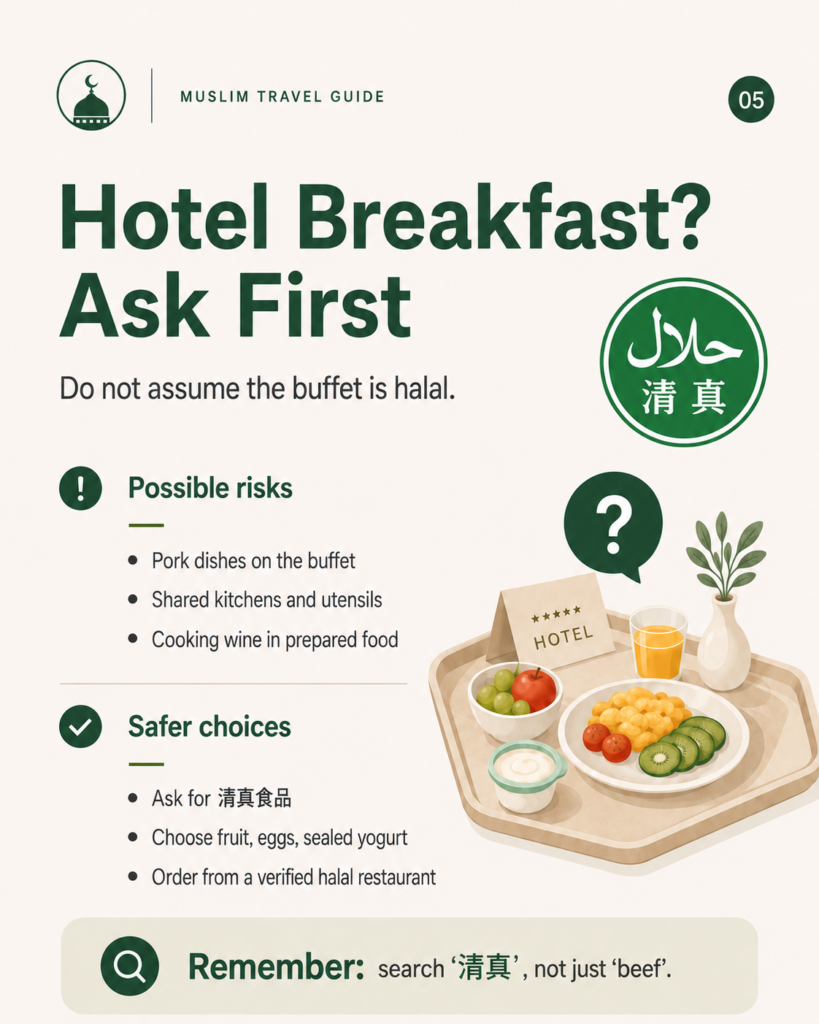
a regular hotel buffet is suitable.
High-Speed Train Days
China’s high-speed
rail network is
an excellent way
to travel between
many cities.
But don’t rely
on the train
having a suitable
halal meal available
when you board.
For longer journeys,
consider arranging
food before departure,
especially if
children are travelling.
You should also
check any current
station and train
rules for carrying
particular foods.
Domestic Flights
If a suitable
special meal is
important, ask
your airline
whether a Muslim
meal can be requested
on your specific flight.
Meal availability,
advance notice
and service policies
depend on the
airline and route.
Don’t assume
every domestic
flight provides
meal service.
Snow Mountains and Remote Scenic Areas
This is where
planning makes
the biggest difference.
At some attractions,
there may be
limited restaurants
or no suitable
halal option
inside the scenic area.
For a day trip,
you may need
to eat before
entering, arrange
a suitable stop
on the way
or bring appropriate
food in accordance
with local rules.
For overnight routes,
it’s worth checking
the restaurant and
hotel arrangements
at each stop
before confirming
the itinerary.
If your itinerary
has a long drive,
a remote hotel
or a late arrival,
identify the next
suitable meal
before you leave
the previous city.
7. The Halal Food Checklist to Save Before Your China Trip
You don’t need
to remember
every Chinese
ingredient or
research hundreds
of restaurants.
Start with this
short checklist.
It’s useful
whether you’re
travelling independently
or arranging
a private tour.
Save This Before Your Trip
My Halal Food Checklist
- Search for 清真餐厅, not just beef restaurants.
- Check recent photos and the actual shopfront.
- Confirm the meat meets your requirements.
- Ask about pork fat, pork broth and cooking wine.
- Check shared equipment if that matters to you.
- Do not assume a hotel buffet is halal.
- Plan meals before long train or mountain journeys.
- Save a few useful Chinese questions offline.
Most useful Chinese word:
Qīngzhēn — Halal
Frequently Asked Questions
Is halal food easy to find in China?
It can be relatively
easy in cities with
established Muslim
communities and suitable
restaurants.
Availability varies
by neighbourhood,
and remote destinations
may require more
planning.
Is beef noodle soup halal in China?
Not automatically.
Look for a suitable
halal restaurant
and confirm the meat,
broth and preparation
meet your requirements.
What does Qingzhen mean?
清真 (Qīngzhēn)
is the Chinese term
commonly used
for halal.
You’ll often
see it on restaurant
signs and food products.
Are vegetarian dishes always halal?
No. A vegetarian-looking
dish may contain
cooking wine,
pork fat or other
ingredients, or
may be prepared
with shared equipment.
Ask when uncertain.
Can I get halal food at Chinese hotels?
Some hotels may be
able to provide
suitable options,
but a regular
buffet breakfast
should not be
assumed halal.
Confirm directly
with the property.
Is all Xinjiang food halal?
No region or cuisine
should be treated
as a blanket guarantee.
Xinjiang has established
Muslim food traditions,
but individual restaurants
and ingredients still
need to be checked.
Can a private China tour include halal meals?
A private itinerary
can be planned around
suitable halal dining
stops and specific
dietary requirements.
Whether meals are
included in the price
depends on the
confirmed tour package.
A Better Way to Enjoy Chinese Food
There’s so much
more to eating
in China than
trying to avoid
the wrong ingredients.
You might discover
a small noodle
restaurant in Xi’an,
try fragrant rice
dishes in Xinjiang
or find a favourite
halal restaurant
during your time
in Chengdu.
That’s part
of the pleasure
of travelling.
Learning a few
Chinese phrases
and checking
restaurants carefully
means you can
spend less time
worrying about
lunch and more
time actually
enjoying your trip.
And if you’re
visiting several
cities, it helps
to plan food
alongside sightseeing,
transport and
your family’s
daily pace.
Planning a Muslim-Friendly China Trip?
Tell us where
you’re going,
your approximate
travel dates
and what matters
most to your family.
Our Chengdu-based
Traverse China team
plans private journeys
with suitable halal
dining stops,
prayer-aware scheduling
and practical
local arrangements.
You can also tell
us if you need
particular food
preparation standards,
are travelling
with young children
or want to explore
China’s Muslim
food culture
along the way.
Restaurant listings, menus,
certification practices
and service availability
can change.
Always verify the current
details and your specific
dietary requirements
before eating or booking.