Foreign tourists can use Alipay in the Chinese mainland without opening a Chinese bank account.
Alipay’s current official guidance says overseas travelers can download the app, register with a mobile number, switch to the international version, add an eligible international credit or debit card, and use it for supported daily purchases.
That is the official answer.
The practical answer is slightly less tidy:
Successfully adding a card does not guarantee that every merchant, QR code, bank or transaction will approve it.
This is where most online guides become confusing. Some make Alipay sound completely effortless. Others make it sound as though a failed coffee payment means the whole system is unusable.
Neither is particularly helpful.
This guide separates three different things:
- What Alipay officially confirms
- What can vary between travelers and transactions
- What to check when a payment fails
I reviewed the current Alipay traveler guidance, Chinese government payment guidance, the current Alipay app listing and recent traveler reports before updating this page.
Traveler reports were used to identify recurring problems—not to invent universal rules.
The answer in 60 seconds
A foreign visitor can normally use Alipay in China by:
- Downloading the official Alipay app
- Registering with an overseas mobile number
- Choosing the international version where available
- Adding an eligible international credit or debit card
- Completing identity verification if requested
- Scanning a merchant’s payment code or showing a personal payment code
You usually do not need:
- A Chinese bank account
- A Chinese-issued card
- A prepaid Alipay balance
- Someone in China to transfer money to you
However, your linked international card is intended for supported daily purchases. It does not support every function available to a mainland Chinese Alipay account.
You should still carry:
- A second card from another bank
- A physical bank card
- Some Chinese yuan
- Access to your banking app
- A working mobile-data connection
- A portable charger
Alipay can be your main payment method.
It should not be your only one.
What is officially confirmed?
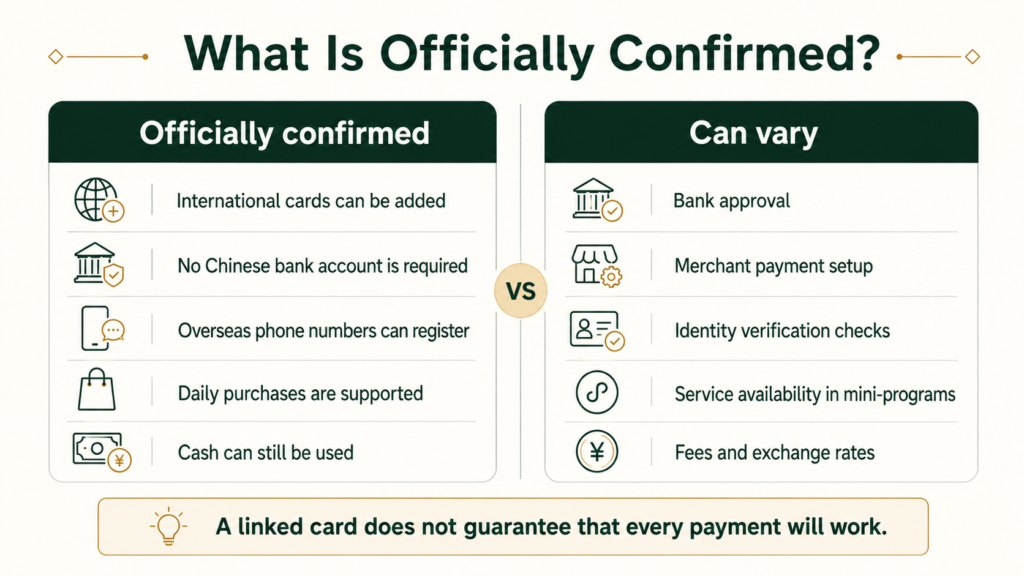
The table below separates the confirmed rules from the parts that can vary.
| Question | Evidence status | Practical answer |
|---|---|---|
| Can foreign tourists add international cards to Alipay? | Officially confirmed | Yes, eligible international credit and debit cards can be added |
| Is a Chinese bank account required? | Officially confirmed | No, not for supported daily purchases |
| Can an overseas phone number be used to register? | Officially confirmed | Yes |
| Is there an international version of Alipay? | Officially confirmed | Yes, it is designed for overseas travelers in China |
| Can linked international cards be used for ordinary purchases? | Officially confirmed | Yes, for supported daily purchases in the Chinese mainland |
| Can a linked international card be used for person-to-person transfers? | Officially confirmed | No |
| Can it be used for red packets and financial products? | Officially confirmed | No |
| Will every international card work? | Not guaranteed | The card network may be supported while the issuing bank still declines a transaction |
| Will every Alipay QR code accept a linked foreign card? | Not guaranteed | Availability can depend on the recipient and transaction setup |
| Will every mini-program work for a foreign visitor? | Not guaranteed | Some services may require a Chinese number, Chinese ID or another payment route |
| Will fees always be the same? | Not guaranteed | Check the amount and any fee displayed before confirming |
| Can cash still be used in China? | Officially confirmed | Yes |
This distinction is the most important part of the guide.
“Alipay supports international cards” and “every payment will work” are not the same statement.
How this guide was checked
This page uses an evidence hierarchy.
Level 1: Current first-party information
The strongest source is Alipay’s own traveler-facing information.
It currently states that overseas travelers can:
- Download and register for Alipay
- Select the international version
- Add international bank cards from major card networks
- Pay for daily purchases in the Chinese mainland
- Use functions including shopping, transport, ride-hailing, flights and hotels
It also confirms that international cards do not support person-to-person transfers, red packets, wealth-management services, insurance services and certain other financial functions.
Level 2: Chinese government payment guidance
Chinese government guidance confirms that overseas visitors can use:
- Mobile payment
- International bank cards where accepted
- Chinese yuan cash
It also specifically names Alipay and WeChat Pay as platforms that allow foreign users to link international cards, including Visa and Mastercard.
Level 3: Current app-store information
The current Alipay app listing says foreign visitors to China can connect a credit card and use Alipay at participating merchants across the country.
App listings are useful for confirming that the service is still actively presented to foreign visitors, but they are not detailed troubleshooting manuals.
Level 4: Traveler reports
Recent traveler discussions repeatedly mention:
- A card being added successfully but later declined
- Payments working at some merchants but not others
- Banks blocking unfamiliar transactions
- Identity-verification problems
- Difficulty testing Alipay before arriving in China
These reports are useful for identifying common questions.
They are not proof that every traveler will encounter the same problem.
A Reddit comment can tell you what happened to one person. It cannot rewrite Alipay’s official policy for everyone.
How to set up Alipay before your trip
Do this several days before flying.
The arrivals hall is not the ideal place to discover that your bank wants to send an authentication message to a SIM card sitting at home.
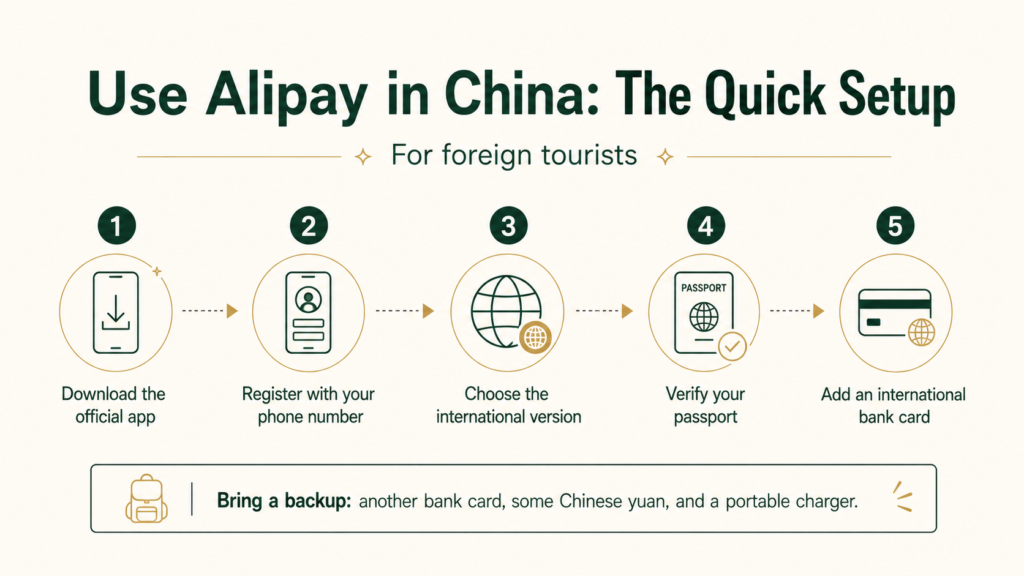
Step 1: Download the official app
Use your phone’s official app store.
Check that the developer is Alipay rather than downloading an unofficial installation file from a random website.
The interface changes regularly. A tutorial recorded two years ago may show different button names or layouts.
Look for sections such as:
- Cards
- Bank Cards
- Payment Methods
- Add Card
- Account
- Identity Information
The exact wording may vary.
Step 2: Register with a number you can continue to access
Overseas users can register with an international mobile number.
Use a number that will remain available during the trip.
You may need it for:
- Login verification
- Security alerts
- Account recovery
- Banking confirmation messages
A travel eSIM often provides data but not a new telephone number.
Many phones allow the eSIM to handle mobile data while the original SIM remains active for incoming messages. Check whether your phone and mobile plan support this before departure.
Step 3: Select the international version
Alipay’s official traveler page says overseas users can choose the international version after signing up.
This version is designed to make common travel services easier to access and includes multilingual functions.
It does not turn every third-party mini-program into a fully international service.
Some services inside Alipay may still:
- Display Chinese text
- Request a Chinese mobile number
- Accept only certain identity documents
- Apply their own payment restrictions
Think of Alipay as a platform containing many services, not one identical checkout system.
Step 4: Add an eligible international card
International credit and debit cards from major supported card networks can be added.
Your bank may ask you to confirm the connection through:
- SMS
- Its banking app
- A one-time password
- An online-purchase approval
Adding the card proves that the initial connection was accepted.
It does not prove that your bank will approve every later transaction.
When possible, add cards issued by two different banks.
Two cards from the same bank are not a strong backup if the restriction comes from that bank’s fraud system.
Step 5: Complete identity verification if requested
Alipay or a service inside it may request identity verification.
Use the information exactly as it appears in your passport.
Check:
- Family name
- Given names
- Middle names
- Passport number
- Date of birth
- Expiry date
When photographing your passport:
- Use clear, even lighting
- Avoid reflections on the information page
- Keep all edges visible
- Make sure the text is sharp
- Use the physical passport rather than an old screenshot
Complete verification only through the official app.
Do not send your passport, payment code or security code to someone who contacts you through social media and offers to “activate” the account.
Step 6: Check your bank before departure
Confirm that:
- International payments are enabled
- Online transactions are enabled
- Your contact details are current
- You can access the banking app abroad
- You can receive security notifications
- You know how to reach the bank internationally
Some banks no longer require a formal travel notice.
That does not mean their fraud-control system will automatically approve every unfamiliar payment.
How do you pay with Alipay?
There are two main methods.
Option 1: Scan the merchant’s code
The merchant displays a payment code.
Open Alipay, select Scan, scan the code, and enter or confirm the amount.
Before approving the payment, check:
- Merchant or recipient name
- Payment amount
- Selected card
- Currency
- Any displayed fee
- Final total
Do not assume that every code represents the same kind of transaction.
The payment methods available can depend on how the recipient or merchant is registered.
Option 2: Show your payment code
Open the payment section and display your personal payment code.
The cashier scans it and Alipay charges the selected payment method.
This is common at:
- Convenience stores
- Supermarkets
- Chain restaurants
- Shopping malls
- Larger attractions
Do not send screenshots of your payment code to another person.
Treat it like payment information.
What can you pay for?
Alipay’s traveler-facing information says linked international cards can be used for daily purchases in the Chinese mainland.
Common travel uses include:
- Shops
- Restaurants
- Hotels
- Ride-hailing
- Public transport
- Flights
- Attraction tickets
- Other supported travel services
The word supported matters.
A service appearing inside Alipay does not necessarily mean every foreign account, foreign card or foreign passport can complete every step.
What can you not do with a linked international card?
According to Alipay’s official traveler FAQ, international bank cards do not support:
- Person-to-person transfers
- Sending red packets
- Receiving red packets
- Wealth-management services
- Insurance services
- Certain other financial services
This is one reason a normal shop purchase may work while an attempt to transfer money directly to an individual does not.
Do not build your travel payment plan around asking someone to send money into your Alipay balance.
For most visitors, the simplest setup is still:
Add an international card and use it directly for supported merchant purchases.
Do you need to preload money?
Usually, no.
A short-term visitor can normally pay directly through the international card linked to Alipay.
You do not usually need to:
- Load a large prepaid balance
- Open a Chinese bank account
- Ask a stranger to transfer money
- Buy an unofficial top-up service
If someone online offers to “fix” your account by receiving an international transfer and sending money back through Alipay, be cautious.
The official card-linking method is simpler and safer.
How is the exchange rate decided?
For payments made through an international card linked to Alipay, the official Alipay traveler FAQ says the exchange rate is provided by the card network and issuing bank.
The final amount shown on your bank-card statement is therefore the best place to confirm:
- The exchange rate used
- Any foreign-transaction charge
- Any bank fee
- The final converted amount
A fee shown by Alipay and a fee charged by your bank are not necessarily the same thing.
Before confirming a larger payment, review the final amount displayed.
For a hotel, private tour or expensive purchase, you can also ask whether the business accepts:
- A direct international card payment
- Bank transfer
- Another payment platform
- Cash
Why can a linked card still fail?
A real Alipay payment can involve several separate layers:
- Your Alipay account
- Your identity information
- The linked card
- The issuing bank
- The card network
- The merchant or recipient setup
- Your internet connection
- The individual transaction
The card appearing in the app only confirms one part of that chain.
This is why the statement below is possible:
“My card linked successfully, worked at one shop, and failed at the next.”
It does not automatically mean the card suddenly became invalid.
The second transaction may have followed a different payment route, triggered a bank security check or required an additional verification step.
The 30-Second Alipay Check
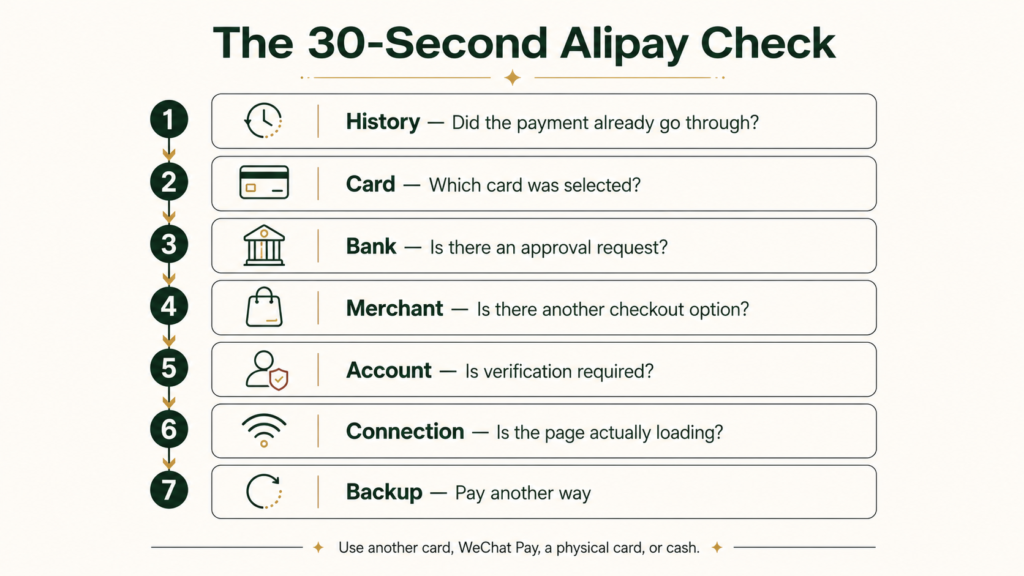
When a payment fails, use this order.
1. History: did the payment already go through?
Check:
- Alipay transaction history
- Your bank’s pending transactions
- The merchant’s confirmation
A slow or frozen screen does not always mean the payment failed.
Do not immediately submit the same payment again.
2. Card: which card was selected?
If several cards are linked, confirm the last four digits.
Manually choose another card if necessary.
3. Bank: is there an approval request?
Open your banking app and look for:
- A fraud alert
- A declined overseas transaction
- A purchase awaiting approval
- A temporarily frozen card
- An online-payment restriction
If contacting the bank, ask:
“Can you see a declined authorization from Alipay or a payment processor in China?”
That is more useful than simply asking whether the card is active.
4. Merchant: does another checkout method work?
If the card works elsewhere but fails with one merchant, ask whether the business has:
- Another Alipay payment method
- WeChat Pay
- A card terminal
- A cash option
Do not turn a merchant-specific failure into a complete reinstall of the app.
5. Account: is verification required?
Check whether Alipay is asking for:
- Passport verification
- Updated identity details
- An account-security check
- Additional transaction confirmation
Complete it inside the official app.
6. Connection: is the payment page actually loading?
Switch between:
- Mobile data
- Trusted Wi-Fi
Then reopen the payment page and check the transaction history before trying again.
7. Backup: can you pay another way?
Use:
- Another bank’s card
- WeChat Pay
- A physical card
- Cash
The goal is to complete the purchase.
You do not receive a medal for defeating the payment screen in single combat.
A faster way to identify where the problem is
| Pattern | Most likely area to investigate |
|---|---|
| The card cannot be added at all | Card eligibility, details, bank restrictions or account verification |
| The card is added but fails at every merchant | Bank approval, identity verification or account security |
| The card works at larger stores but fails with one recipient | Merchant or transaction setup |
| One bank’s card fails but another works | The first issuing bank or card |
| Payments worked earlier and suddenly stopped | Bank fraud control, account review or additional verification |
| The payment stays pending | Connection delay or incomplete confirmation |
| Several cards fail everywhere | Account-level issue or Alipay support case |
This is a diagnostic framework, not an Alipay rulebook.
It helps you decide where to look first.
What recent traveler reports can—and cannot—prove
Recent traveler discussions frequently describe cards that were linked successfully but later declined, merchant messages saying international-card payment was unsupported, and verification screens that did not complete as expected.
Those reports are worth reading because they reveal where official setup instructions may feel incomplete.
But they have serious limitations.
A typical post may not tell you:
- Which issuing bank was used
- Whether overseas payments were enabled
- Whether the merchant was a registered business
- Whether the recipient was an individual
- Whether identity verification was complete
- Whether the payment happened inside or outside China
- Whether a VPN, roaming connection or local network was being used
- Whether the transaction later succeeded
That is why this guide does not turn a single Reddit solution into a universal rule.
For example, some travelers say changing their network or disabling a VPN solved a verification or payment loop.
That may be useful to try.
It is not the same as an official Alipay statement that every payment must be made without a VPN.
Use traveler reports to generate troubleshooting ideas, not to replace first-party information.
Should you also set up WeChat Pay?
I would.
You may use Alipay for almost the entire trip, but WeChat Pay provides another payment route.
One app may work when:
- The other app rejects a particular card
- A service is built into that platform
- A merchant prefers one checkout method
- One account requires additional verification
The reverse can happen on the next transaction.
There is no need to become loyal to a payment app.
You are trying to buy lunch, not join a football club.
Should you carry cash?
Yes.
Chinese government guidance confirms that overseas visitors can use cash, bank cards and mobile payments.
Cash is useful when:
- Your phone battery dies
- Mobile data stops working
- Your bank blocks a payment
- A merchant payment route does not support your linked card
- You are in an area with weaker connectivity
- You simply want to move on
Carry some smaller notes if possible.
A business may accept cash but have difficulty providing change for a large note used for a very small purchase.
You do not need enough cash for the entire trip.
You need enough to survive an inconvenient afternoon.
The payment setup I would actually recommend
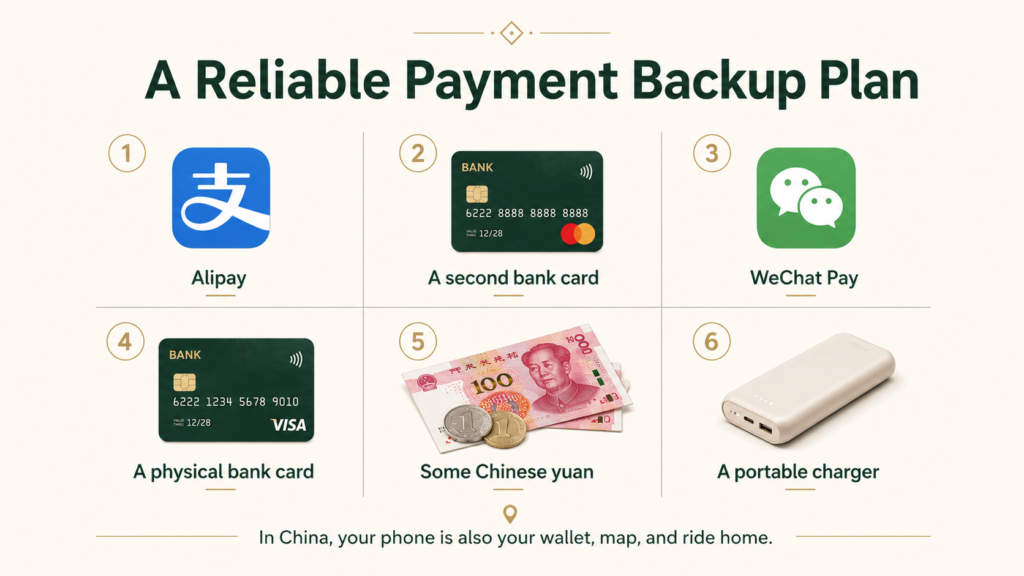
For a first trip to China:
- Alipay linked to a primary card
- A second card issued by another bank
- WeChat Pay as another mobile option
- Two physical bank cards
- Some Chinese yuan
- Mobile data that works after landing
- Access to banking verification messages
- A portable charger
- Bank support details saved offline
- The official Alipay customer-service number saved
Alipay currently lists the following customer-service details:
- 0571-2688 6000 when calling from a local Chinese number
- +86 571 2688 6000 when calling from an overseas number
- Service hours: 08:00–24:00, GMT+8, Monday to Sunday
Verify those details on the official Alipay page before traveling, as service information can change.
Before-you-fly checklist
A few days before departure:
- Download the official Alipay app
- Register with a number you can keep active
- Select the international version
- Add your primary international card
- Add another card from a different bank
- Complete identity verification if requested
- Enable international and online transactions
- Confirm access to your banking app
- Check how you will receive security messages
- Set up WeChat Pay as a backup
- Prepare some Chinese yuan
- Save bank and Alipay support details
- Pack a portable charger
You may not be able to complete a realistic merchant payment test from outside China.
A remote QR code may not behave like an ordinary in-person merchant transaction.
The goal is not to prove that every payment will work.
The goal is to prevent one declined transaction from becoming a travel emergency.
Frequently asked questions
Can foreign tourists use Alipay without a Chinese bank account?
Yes. Eligible international credit and debit cards can be added and used for supported daily purchases in the Chinese mainland.
Can I register without a Chinese phone number?
Yes. Overseas mobile numbers can be used to register.
Keep access to the number in case a login or verification message is required.
Can I use a foreign debit card?
Eligible international debit cards from supported card networks can be added. The issuing bank still decides whether to approve an individual transaction.
Does adding my card guarantee that every payment will work?
No.
Adding the card and approving a transaction are separate processes. The bank, merchant setup, account verification and transaction itself can affect the result.
Why can I pay a business but not transfer money to a person?
Alipay officially states that linked international cards support daily purchases but do not support person-to-person transfers.
Do I need to load money into an Alipay balance?
Usually, no. Most short-term visitors pay directly through the linked international card.
Who decides the exchange rate?
Alipay says the card network and issuing bank provide the exchange rate for payments made with an international card. Check your final card statement.
Can I rely only on Alipay?
I would not.
Carry another card, cash and preferably another mobile-payment option.
Where can I contact Alipay?
Use the Help Center inside the official app or the customer-service information published on Alipay’s official traveler page.
Planning your first trip to China?
Payment is usually the first practical concern.
After that, the questions tend to become:
- Is the hotel actually in a useful location?
- Can this airport or train connection realistically work?
- Are too many cities being fitted into the trip?
- Which attractions need advance booking?
- Would private transport make part of the route easier?
I am a China-based travel planner helping international visitors build realistic itineraries and arrange private transportation, local guides and on-the-ground travel services.
I cannot unlock an Alipay account or override a bank decline.
I can help make sure the rest of the trip does not depend on one fragile connection, one unrealistic transfer or one badly located hotel.
Send me:
- Your travel dates
- Number of travelers
- Cities you are considering
- Approximate budget
- The part of the trip you are most unsure about
You do not need a finished itinerary.
WhatsApp: +86 191 1314 8214
Final answer
Foreign tourists can use Alipay in China with eligible international cards and without opening a Chinese bank account.
What cannot be promised is that every card, merchant, mini-program and transaction will behave identically.
Set up the account before flying. Keep access to your bank. Carry another card and some cash. When a payment fails, identify whether the problem follows the account, card, bank, merchant or individual transaction.
That is usually more useful than deleting the app and starting again.
And bring the portable charger.
About the author
Nico is a China-based travel planner who helps international visitors build realistic itineraries and arrange private transportation, local guides and travel services across China.
WhatsApp: +86 191 1314 8214
Editorial and evidence policy
This page separates:
- Official platform information
- Chinese government payment guidance
- Recurring traveler reports
- The author’s practical recommendations
Traveler anecdotes are not presented as universal platform rules.
This page was last checked against current first-party information on June 13, 2026 and should be reviewed whenever Alipay changes its international-card, verification or fee policies.
Sources checked
- Alipay+ — Pay in the Chinese Mainland
- The State Council of the People’s Republic of China — Payment Service Guide for Overseas Visitors to China
- The State Council of the People’s Republic of China — mobile-payment limits and payment-accessibility guidance
- Current Alipay listings in official mobile app stores
- Recent traveler discussions in r/travelchina, used to identify recurring questions rather than establish official rules