I see versions of the same question all the time:
“I’ve booked my flights and hotels, downloaded Alipay, and saved a few places on my map. What am I forgetting?”
Usually, the answer is not another attraction or restaurant reservation.
It is your phone connection, payment backup, train account, Chinese hotel address, and a realistic plan for getting from the airport to your first hotel when you are tired and slightly confused.
I help international travelers plan trips around China, and most first-time questions are surprisingly similar. People are rarely worried about which attraction is the most beautiful. They are worried about whether their card will work, whether a train connection is realistic, or whether the hotel they booked is actually convenient.
The good news is that China is not particularly difficult to travel around once the basic systems are working.
The annoying part is arriving and discovering that your bank has blocked a payment, your hotel address only exists in English, or the train-booking website does not like the way you entered your middle name.
So this is the practical checklist I would go through before a first trip to China.
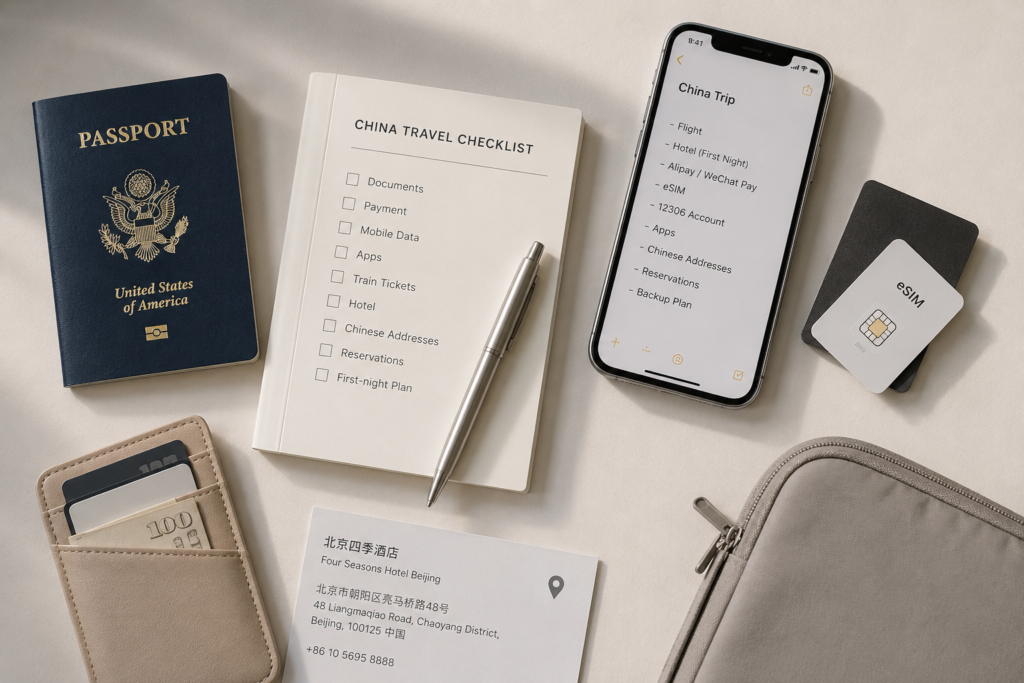
The quick answer
Before flying to China, I would set up:
- Entry documents and the arrival card
- Alipay and WeChat Pay
- At least two payment backups
- Mobile data that works immediately after landing
- A small group of genuinely useful apps
- Chinese versions of every important address
- A verified China Railway account
- Your first hotel and airport transfer
- Accommodation registration, if you are not staying in a hotel
- Reservations for the attractions you genuinely care about
- Translated dietary or medical information
- A simple first-night backup plan
You do not need 20 apps, three spreadsheets and a PhD in QR codes.
You just need the important things to work before you land.
1. Check your entry rules again
Even if you checked the rules several months ago, check them again shortly before departure.
China’s visa and visa-free policies have changed frequently in recent years. Do not rely entirely on an old blog post or something a friend remembers from a previous trip.
Check the rules for the passport you are actually traveling with, not simply your country of residence.
Confirm:
- Whether you need a visa
- How long you are allowed to stay
- Whether your passport has enough remaining validity
- Whether you need proof of onward travel
- Whether you should carry hotel confirmations
- Whether your entry arrangement limits where you can travel
Foreign visitors can now submit their arrival information online before traveling to China.
The official online arrival card service is free. Be careful with unofficial websites asking for payment, because there have already been fake arrival-card websites targeting travelers.
If you do not complete it beforehand, electronic facilities and paper arrival cards are still available at entry ports.
I would also save offline copies of:
- Passport information page
- Visa, where required
- Flight bookings
- First hotel booking
- Travel insurance
- Arrival card confirmation
Airport Wi-Fi is not where I want to start searching through six months of emails.
2. Set up both Alipay and WeChat Pay
Foreign visitors can use mobile payments in China by linking eligible international bank cards to Alipay or WeChat Pay.
I would set up both, even if Alipay becomes your main payment app.
Why?
Because one platform may work better with a certain merchant, mini-program or bank card. Having a second payment app already verified is much easier than registering it outside a railway station while your main payment is being declined.
Before leaving home:
- Register with your regular mobile number.
- Complete any required passport verification.
- Link your main bank card.
- Add a second card from a different bank if possible.
- Tell your bank that you will be traveling.
- Learn how to scan a merchant’s QR code.
- Learn how to display your own payment code.
Your bank may still apply its own security checks, even when the card has been added successfully.
Do not wait until you are standing at a restaurant cashier with six people behind you to test everything for the first time.
3. Bring physical cards and some cash anyway
Mobile payment is extremely convenient in China, but “widely used” does not mean “physically incapable of failing.”
Payments can be declined because of:
- Your bank’s fraud controls
- An incomplete verification process
- A temporary network problem
- A merchant’s payment settings
- A transaction limit
- Your phone running out of battery
I would carry:
- Two physical bank cards, preferably from different banks
- A modest amount of Chinese yuan
- A portable charger
- Your bank’s international support number
Cash remains a valid payment method.
The practical issue is that some small businesses may not have much change, so avoid relying entirely on large-value notes.
Think of cash as an emergency exit, not your main travel strategy.
4. Decide how your phone will connect before you land
This is one of the most common first-trip mistakes.
People spend weeks choosing hotels and then decide they will “sort out the internet at the airport.”
I would not.
Your main options are:
International roaming
Usually the simplest choice for a short trip.
You keep your regular phone number, which is helpful for receiving banking messages and account-verification codes.
The main disadvantage is cost.
A travel eSIM
Often convenient for visitors who mainly need mobile data.
Install it before departure and confirm that your phone supports eSIM. Some travel eSIMs provide data only and do not include a Chinese phone number.
Also check how the provider routes its data. Do not assume every eSIM will give you exactly the same access to the international apps you normally use.
A Chinese physical SIM card
Potentially useful for a longer stay or when you need a local phone number.
It may require more time to purchase and activate, and normal local-network restrictions will apply.
The most important question is not:
“Which company is the best?”
It is:
“Will this setup get me online immediately, let me receive banking codes and give me access to the apps I actually need?”
If Google, Gmail, WhatsApp, Instagram or other international services matter to you, work out the answer before departure.
Do not assume hotel Wi-Fi will solve everything.
5. Do not download every China-related app you see
You do not need half the App Store.
For most first-time visitors, I would start with:
- Alipay for payments and useful mini-programs
- WeChat for communication and backup payment
- 12306 or Trip.com for train bookings
- A map app that works reliably in China
- A translation app with offline language support
- Your airline and hotel-booking apps
Ride-hailing and several other travel services can also be accessed from inside Alipay, so you may not need a separate app for every task.
The goal is not to have the most apps.
The goal is to know exactly which app you will open when you need to:
- Pay
- Find your hotel
- Book a train
- Call a car
- Translate a sentence
- Retrieve a booking
Log in before departure. Do not simply download the apps and assume registration will work perfectly after landing.
6. Save every important location in Chinese
An English hotel name may be perfectly understandable to you and completely useless to a taxi driver.
Before departure, save the Chinese name and address of:
- Your hotel
- Airports
- Railway stations
- Important attractions
- Restaurants you particularly want to visit
- Your next destination
- Emergency contacts
Take screenshots and make sure they remain available offline.
For hotels, I would save:
- Chinese hotel name
- Complete Chinese address
- Front-desk phone number
- A map pin
- Booking confirmation
Also remember that Chinese cities often have several railway stations.
“Beijing Railway Station,” “Beijing South Railway Station” and “Beijing West Railway Station” are not interchangeable suggestions.
The exact station matters.
7. Register for 12306 before you urgently need a train ticket
12306 is the official China Railway ticketing platform.
Its English website supports ticket purchases using valid foreign passports. Foreign passengers normally use the same passport used for the booking when entering the station and boarding the train.
The part that causes the most frustration is usually identity information, not choosing the train.
Enter your name exactly as required and check:
- Family name and given-name order
- Middle names
- Spaces
- Passport number
- Passport expiration date
Register early enough to deal with any verification issue without pressure.
Trip.com is often easier for international visitors because the interface and customer support may feel more familiar. However, it is a third-party platform and may charge service fees depending on the booking.
My practical view is:
- Use 12306 if you want the official platform and are comfortable setting it up.
- Use Trip.com if you prefer a simpler international interface.
- Do not begin passport verification on the day an important train becomes available.
You usually do not need a traditional paper ticket. Keep the booking information saved, but your passport is the important document for the journey.
8. Treat your first hotel differently from the rest
Your first night is not the time to experiment with a mysterious apartment that has no reception desk, unclear instructions and four different locations on the map.
For the first hotel, I would prioritize:
- A clearly listed address
- A staffed reception desk
- Recent reviews from international travelers
- Easy access from the airport or railway station
- A working phone number
- Clear late-arrival instructions
If your flight arrives after midnight, message the hotel beforehand.
Also save the hotel’s Chinese name and address. Do not assume an English booking confirmation will be enough for the driver.
This is also something I check when helping travelers review a China itinerary. A hotel may look central on a booking platform but still be inconvenient for the airport, railway station or the following day’s route.
If you are unsure about your first-night hotel, send me the hotel name, arrival time and next destination. I can usually tell quite quickly whether the arrangement makes sense.
Ask Nico on WhatsApp:+86 191 1314 8214
Once you are settled, you can become more adventurous with the rest of your accommodation.
9. Understand accommodation registration
When a foreign visitor stays in a hotel, the hotel normally completes the required accommodation registration during check-in.
If you stay somewhere other than a hotel—such as a private home, certain apartments or with a friend—the guest or the person providing the accommodation is responsible for completing the registration.
For non-hotel accommodation, the registration is generally required within 24 hours of arrival.
As of June 2026, online accommodation registration for non-hotel stays is being piloted in:
- Hebei
- Liaoning
- Zhejiang
- Hubei
- Guangxi
- Chongqing
- Sichuan
In these regions, registration may be completed through official National Immigration Administration channels.
Offline registration through local public security authorities remains available. In other parts of China, follow the local registration procedure rather than assuming the online pilot is available nationwide.
Before booking a private apartment or staying with someone, ask:
“Can you help foreign guests complete the required accommodation registration?”
Do not assume a host understands the process simply because the property is listed on an international booking platform.
10. Pre-book what matters, but do not pre-book every hour
Some popular attractions use passport-based reservations, timed entry or daily visitor limits.
If there is one place you would genuinely be upset to miss, check its booking rules before traveling.
This may include:
- Major museums
- Famous historical sites
- Popular scenic areas
- Performances with limited seating
- Attractions during public holidays
However, do not turn the entire trip into a military operation.
Leave room for:
- Bad weather
- Jet lag
- Delayed transport
- A place you unexpectedly enjoy
- A meal that lasts longer than planned
- Simply being tired
Reserve the difficult things.
Keep the easy things flexible.
11. Translate dietary restrictions, allergies and medical information
Do not rely on saying “no meat” or showing someone a photograph of a vegetable.
If you have an allergy, religious dietary requirement or medical condition, prepare a clear Chinese translation before traveling.
The translation should explain exactly what you cannot eat or what assistance you may require.
For example, these statements are not equivalent:
- “I prefer not to eat peanuts.”
- “I have a severe peanut allergy.”
- “This food must not contain peanuts or peanut oil.”
Save the translation as both text and an image.
For a serious allergy or medical condition, have the wording checked by someone fluent in Chinese rather than relying entirely on automatic translation.
You should also save:
- Your medication names
- Emergency contact details
- Travel-insurance information
- Any critical medical instructions
Hopefully, you will never need them.
That is the point of preparing them.
12. Make your first night deliberately boring
The first night is where small problems feel much bigger.
You are tired, your phone battery is low, and the airport suddenly seems much larger than it looked on YouTube.
Before flying, decide:
- How you will get from the airport to the hotel
- What you will do if your main payment method fails
- How you will contact the hotel
- Where the Chinese address is stored
- Whether reception will still be open
- Which internet connection your phone will use
- Who you will contact if the flight is delayed
My ideal first arrival is honestly quite boring:
My phone connects. Payment works. The driver finds the hotel. Reception has the booking. I go upstairs and sleep.
Save the spontaneous adventure for the next morning.
What I would not worry about too much
Many first-time visitors overprepare for the wrong things.
You do not need to:
- Speak fluent Chinese
- Carry enough cash for the entire trip
- Have a Chinese bank account
- Book every meal in advance
- Join a tour in every city
- Understand every mini-program before arrival
- Plan every hour of every day
You mainly need:
- A working phone
- Reliable payment options
- The correct documents
- Chinese versions of important addresses
- A realistic route
Once those are sorted, China becomes much easier.
My actual pre-flight checklist
The day before flying, I would check:
- Passport and visa or visa-free eligibility
- Arrival card completed through an official channel, where applicable
- Alipay verified and cards linked
- WeChat Pay available as a backup
- Cash and physical bank cards packed
- eSIM or international roaming activated
- Essential apps installed and logged in
- Hotel and railway-station addresses saved in Chinese
- Train-booking account registered
- First-night transfer decided
- Dietary or medical translations saved
- Bookings available offline
- Portable charger packed
That covers most of the practical problems first-time travelers worry about.
Frequently asked questions
Do I really need both Alipay and WeChat Pay?
Not necessarily, but having both provides a useful backup. Many international visitors find Alipay easier to start with, while WeChat is also useful for communication and certain local services.
Can I travel in China using only cash?
Cash remains valid, but relying only on cash may be inconvenient. Mobile payment, physical cards and some emergency cash make a more reliable combination.
Do I need a Chinese phone number?
Not every traveler needs one. Many short-term visitors manage with international roaming or a travel eSIM. A Chinese number may be useful for certain local services or a longer stay.
Should I book trains before arriving in China?
For popular routes, weekends and public holidays, planning ahead is sensible. At minimum, register your account and check your passport information before the tickets become important.
Does my hotel register my stay?
Hotels normally complete accommodation registration during check-in. For stays in private homes or other non-hotel accommodation, the guest or host may need to complete the registration separately.
Is China difficult to visit without speaking Chinese?
It requires some preparation, but it is manageable. Mobile payment, translation tools, ride-hailing and saved Chinese addresses solve many everyday problems.
Still not sure whether your itinerary makes sense?
I am a China-based travel planner helping international travelers with:
- Itinerary planning
- Private transportation
- Local guides
- Hotel and route coordination
- On-the-ground travel arrangements in China
You can message me with:
- Your travel dates
- Number of travelers
- Cities you are considering
- Approximate budget
- The part of the trip you are most unsure about
You do not need to have a finished itinerary.
I will first help you identify whether the route is realistic, which connections may be too rushed and where the plan could be simplified.
Message Nico on WhatsApp: +86 191 1314 8214
Final thought
China is not a destination where I would recommend arriving completely unprepared and hoping to figure everything out after landing.
But it is also not nearly as difficult as many first-time visitors imagine.
Set up your payment, internet, train account and Chinese addresses before departure. Make the first night easy.
Once those systems are working, the actual trip usually feels much simpler than the preparation made it sound.
And no—you probably do not need another app.
Contact Nico
WhatsApp: +86 191 1314 8214